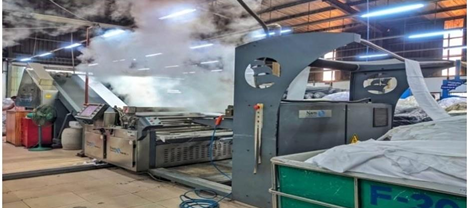
Welcome back to the latest installment of my internship journal! After exploring the vibrant, chemically intensive worlds of dyeing and printing, we now move to the crucial final stage of wet processing: Finishing. At FOUR H Group, this department is where the fabric truly comes to life, acquiring the specific dimensional stability, hand feel, and performance properties demanded by international buyers.
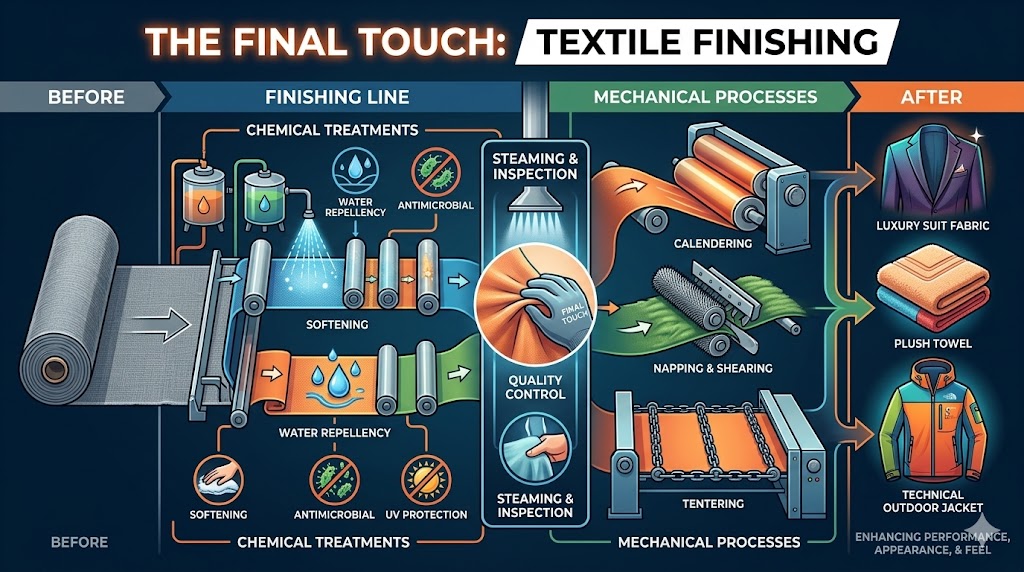
While dyeing gives fabric its color, finishing determines how it will behave when a consumer wears and washes it. From mechanical adjustments to chemical softening, finishing transforms raw, processed fabric into a premium, retail-ready material.
Moisture Removal: Slitting and Squeezing
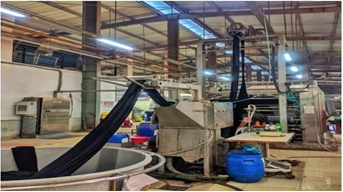
Following the dyeing process, fabrics are heavily saturated with water. For tubular knit fabrics, the first step is often slitting, where the fabric tube is cut open to form an open-width flat fabric. Simultaneously, it passes through a squeezer or hydro-extractor.
This mechanical process utilizes heavy padding mangles to squeeze out excess moisture. Efficient squeezing is critical; every drop of water mechanically removed here saves significant thermal energy during the subsequent drying stages, making it a key focal point for energy optimization and sustainability on the factory floor.
Squeezer Machine
Relaxation and Drying
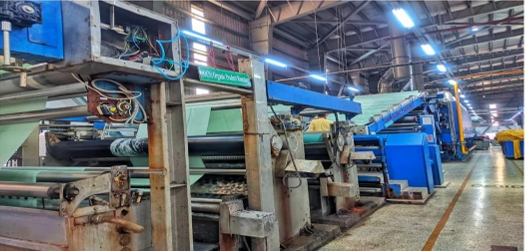
Dryer Machine
Once the bulk of the water is removed, the fabric must be completely dried. At FOUR H Group, I observed the use of tensionless dryers. Unlike older methods that pull the fabric taut, tensionless drying allows the fabric to overfeed onto a conveyor belt. Hot air is circulated to dry the material while it remains in a relaxed state.
This relaxation is vital for knitted fabrics. The mechanical stresses accumulated during knitting and dyeing are relieved, allowing the loops to return to their natural, unstretched geometry. This significantly reduces the residual shrinkage of the final garment.
The Stenter: Heat Setting and Chemical Application
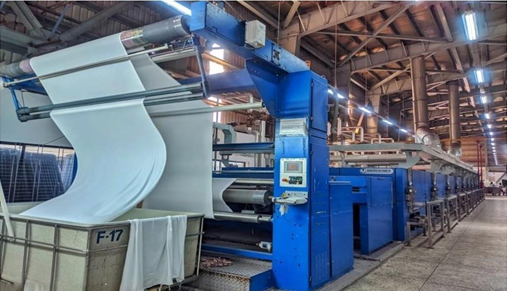
The stenter is arguably the most important machine in the finishing department. It serves multiple purposes: stretching the fabric to its precise required width, correcting bowing and skewing in the grain line, and applying chemical finishes such as softeners, resins, or water repellents via a padding trough.
As the fabric is gripped by pins or clips along its selvedges, it travels through several heated chambers. For synthetic blends, the high temperatures heat-set the thermoplastic fibers, locking in the fabric’s dimensions permanently. The heat also cures any chemical finishes applied, ensuring they bond securely to the textile surface.
“The energy demands of stentering and drying are immense. Observing these high-heat processes reinforces my drive to research lower-temperature curing agents and more efficient moisture management systems. Sustainable finishing isn’t just about eco-friendly chemicals; it’s heavily dependent on thermal energy conservation.”
Stenter Machine
Dimensional Control: Compacting
The Compacting Machine ensuring dimensional stability
The final mechanical finishing step for knits is compacting. Even after relaxation drying and stentering, knitted fabrics can still shrink when washed by the consumer. The compactor addresses this by intentionally pre-shrinking the fabric. The fabric is fed through heated rollers and a specialized felt blanket system that mechanically compresses the length of the fabric. By forcing the knitted loops closer together, the compactor ensures the fabric meets strict buyer shrinkage tolerances (typically under 5%).
Conclusion
The Finishing department is the ultimate quality gatekeeper. It dictates the drape, the softness, and the longevity of the final product. My rotation here at FOUR H Group has highlighted the intricate balance between mechanical engineering, thermal dynamics, and textile chemistry required to produce world-class garments. As I look toward my future master’s studies, optimizing these final stages for both performance and environmental impact remains a top priority.