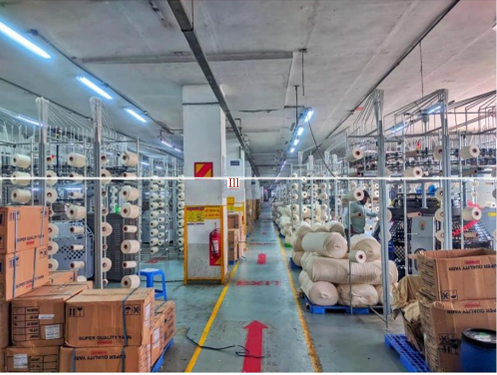
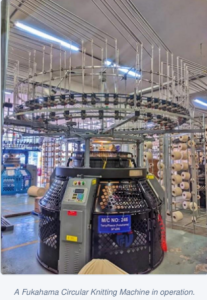
Understanding the mechanics of fabric formation is essential for any textile professional. During my industrial training at FOUR H Group in Chattogram, I gained hands-on experience in the weft knitting section, where continuous threads are interloped by needles to create versatile fabric structures. Here is an inside look at the machinery, materials, and quality control systems that drive large-scale knit production.
Machine Setup and Floor Capacity
The knitting floor at FOUR H Group is equipped with 220 high-speed circular knitting machines, ensuring a massive production capacity of 50,000 kg for the primary knitting unit alone. Different brands are utilized to meet specific structural and gauge requirements.
Machine Brand
Origin
Total Units
Fukuhara
Japan
48
Fukahama
Taiwan
44
Smart
Taiwan
40
Pailung
Taiwan
25
Goang Lih
Taiwan
23
Huntex
Taiwan
17
Mayer & Cie
Germany
13
Zentex
Singapore
10
Yarn Varieties and Knitted Structures
Achieving the exact GSM and hand-feel requires the right combination of yarn and machine settings. The floor consistently processes a variety of high-quality yarns sourced from suppliers across the globe.
Common Yarns Utilized:
Combed and Grey Melange
Cotton and Bamboo (CB) blends
Bamboo (Viscose)
Chief Value Cotton (CVC 60/40)
Primary Fabric Structures Manufactured:
Single Jersey 95/5 (95% cotton, 5% Lycra) and 90/10
Interlock and Pointal Rib
1×1 Rib and 2×2 Rib
Fleece / Terry
Quality Control and Fabric Inspection
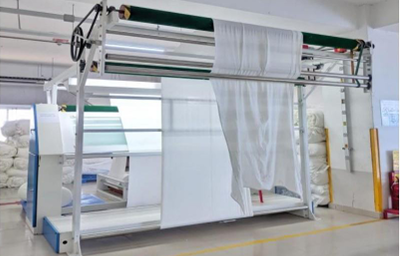
Fabric Inspection Machine.
To maintain standards for major buyers like H&M, PVH, and Next, rigorous on-line and off-line quality checks are mandatory. The facility utilizes the standard 4-Point Inspection System to evaluate knitted rolls before they proceed to wet processing.
Defect Size
Penalty Points
1 inch to 3 inches
1 point
Over 3 inches to 6 inches
2 points
Over 6 inches to 9 inches
3 points
Over 9 inches (or any hole)
4 points
Acceptance Criteria:
A Grade: Up to 20 points
B Grade: 21 to 28 points
Reject: Above 28 points
Identifying faults early is critical to reducing waste. The most common defects monitored on the floor include needle marks, lycra out, pin holes, oil stains, thick/thin yarn spots, and slubs. Ensuring the central cylinder, sinker rings, and positive feeders are perfectly aligned is the key to minimizing these issues and keeping production running smoothly.