
Designing the Future: How Virtual Prototyping is Revolutionizing Meditech
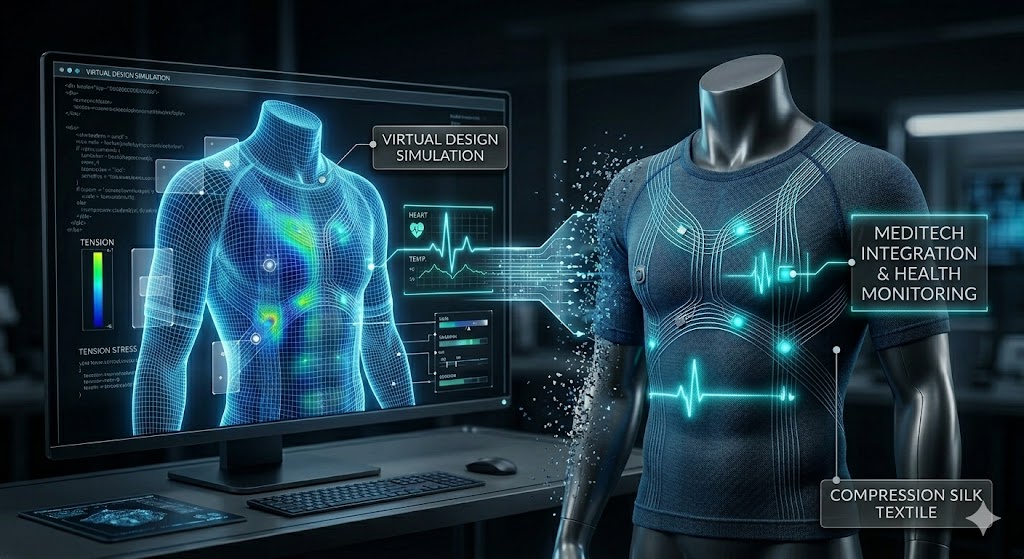
The textile industry is undergoing a digital and biological transformation. We are moving far beyond traditional cut-and-sew operations into an era where garments are engineered to save lives, and their creation begins entirely in the digital realm.
By combining Virtual Prototyping with Meditech (medical textiles), engineers are developing the next generation of smart garments with unprecedented precision and zero physical waste. Here is a look at how 3D simulation is making smart fabrics a reality.
The Rise of Meditech and Smart Fabrics
Meditech represents the intersection of healthcare and textile engineering. Today, we aren’t just talking about hospital gowns or bandages; we are talking about smart fabrics seamlessly integrated with microscopic sensors, conductive threads, and microcontrollers.
These garments can perform real-time health monitoring—tracking heart rates, measuring body temperature, and even detecting chemical variations in sweat. But designing a garment that functions as a wearable medical device introduces a massive challenge: precision fit. If a biometric sensor does not sit perfectly against the wearer’s skin with the correct tension, the data will be inaccurate. This is where digital engineering steps in.
The Power of the "Digital Twin"
Before a single piece of smart fabric is cut, modern engineers use advanced 3D garment simulation software—such as CLO3D or Lectra—to create a highly accurate “digital twin” of the garment.Virtual prototyping allows developers to:
- Analyze Tension and Strain: Engineers can view real-time stress maps on the digital avatar to ensure conductive threads won’t snap during movement and that sensors maintain consistent pressure against the skin.
- Test Component Placement: Placing rigid components (like micro-batteries or Bluetooth transmitters) into flexible fabrics is tricky. 3D simulation allows for testing the drape and weight distribution of these components virtually.
- Eliminate Physical Waste: Traditionally, achieving the perfect fit for a complex smart garment would require dozens of physical samples. Virtual prototyping drastically streamlines the merchandising and development phase, reducing textile waste and saving months of trial-and-error.
Merging Bytes and Threads
The true magic happens when data from the digital prototype dictates the physical manufacturing process. By mapping out the exact electrical pathways and sensor placements in a 3D environment, developers can export those precise specifications directly to automated knitting machines or robotic assembly lines.
This seamless transition from software to physical textile ensures that the final Meditech garment is not only life-saving but also comfortable, durable, and ready for mass production.
The Takeaway: The future of healthcare apparel isn’t just woven; it is coded. As we continue to push the boundaries of what textiles can do, the integration of 3D simulation software and smart materials will be the driving force behind the next great medical breakthrough.