Welcome back to my internship journey series! For this installment, we are moving from the loud, heavy machinery of the production floor and stepping inside a controlled environment: The Physical Lab. While other departments focus on producing the fabric, the Physical Lab is where we prove its quality and performance. This lab ensures that finished textiles meet the rigorous structural and behavioral specifications demanded by buyers before any garment is even cut. Physical testing focuses on the mechanical properties and construction of the textile, from basic weight calculations to testing the absolute breaking point of a fabric strip. The instruments found here are highly precise and are maintained in specific environmental conditions (standard atmosphere of 20°C ± 2°C and 65% ± 4% R.H.) to ensure consistent results. Let’s take a closer look at the key equipment I worked with during this rotation.
1. Fabric Construction and Weight Analysis
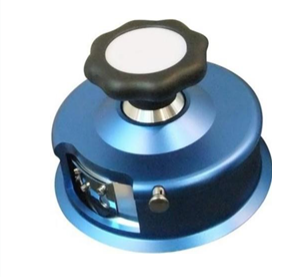
GSM cutter
One of the first measurements taken for any new fabric style is determining its basic construction characteristics.
A fundamental property of textiles is its fabric weight, measured in grams per square meter (GSM). This cutter is designed for one specific job: to accurately cut a precisely dimensioned circular piece of fabric, typically with an area of 100 cm² (indicated by the size of the base). The cutter uses a hand-operated knob to rotate several small blades, cutting effortlessly through woven or knitted samples. Once cut, these precise samples are weighed on a sensitive electronic balance. The weight in grams is then multiplied by 100 to quickly determine the fabric’s total GSM. GSM is critical contract information for buyers and determines fabric cost and density.
2. Strength and Durability Testing
How much stress can a fabric take before it tears, bursts, or stretches too far? These tests define a textile’s suitability for specific products.
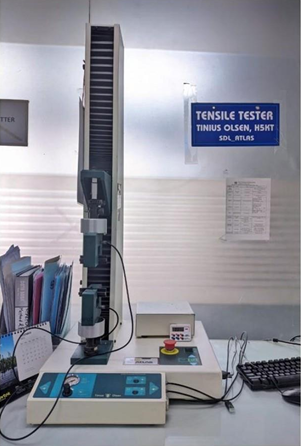
Tensile strength is primarily tested on woven fabrics to measure breaking force and elongation (how much it stretches before breaking). The large vertical instrument shown above is a universal tensile testing machine. Grips clamp onto a strip of fabric at both the top and bottom. The upper grip moves upward at a set speed, pulling the fabric in a vertical straight line until the sample fails. A load cell measures the force required. The machine is often controlled by a computer program, generating a force-vs-elongation graph automatically
Tensile Tester (Tinius Olsen H5KT)
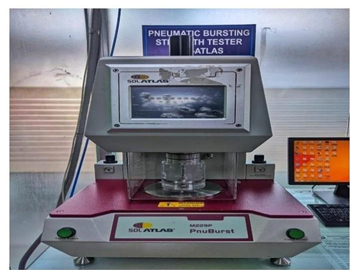
Tensile testing isn’t effective for highly elastic textiles like knitted fabrics. Instead, knitted fabrics are tested using a Bursting Strength test. The apparatus clamps the circular fabric specimen securely over an elastic rubber diaphragm. Air pressure is then pumped under the diaphragm, causing it to expand like a balloon against the fabric. The pressure continues to increase until the fabric cannot withstand the multidirectional force and ‘bursts’. The maximum pressure recorded determines the fabric’s strength in kPa or PSI.
3. Surface Properties and Performance
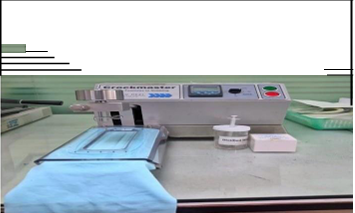
These tests measure how the fabric maintains its appearance and color during wear and tear. Colorfastness to rubbing (or crocking) measures how well the dyestuff is attached to the fabric fibers, or if it will easily transfer (smudge) onto other surfaces. The standard apparatus features a sample of knitted fabric clamped down onto a base. A small white square of standard cotton cloth is attached to a peg on a mechanical arm. This arm rubs back and forth over the sample under a controlled pressure, for a set number of cycles (often 10 for basic testing). The white crock cloth is then evaluated against a standard Gray Scale to rate the amount of color transfer, from 5 (perfect) down to 1 (severe transfer). This test is done separately in both dry and wet conditions.
Crockmeter
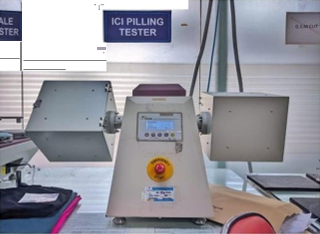
ICI Pilling Tester
Pilling refers to the unsightly little balls of fiber that form on the surface of some fabrics over time. The ICI Pilling Tester accelerates this process by tumbling fabric samples inside standard cork-lined boxes for an extended period, which can range from 1 to 24 hours. Specimens are prepared by wrapping strips of the test fabric around special flexible tubes. This vigorous tumbling simulates years of wear. After the test cycle, the specimens are inspected under controlled lighting and graded against a photographic reference scale to rate their resistance to forming pills.
4. Chemical and Solution Testing
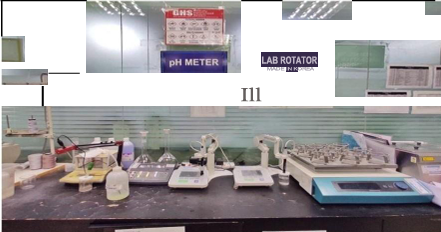
While predominantly a physical lab, some basic chemical analysis is also necessary. This station includes a multi-flask rotary shaker or lab rotator table for mixing extraction solutions. Also present is a standard benchtop pH Meter. The pH of finished textiles is critical for skin safety; many export markets require fabrics to fall within a safe pH range (e.g., pH 4.0 to 7.5). The lab must perform extraction procedures and measure the resulting solution with the calibrated probe to ensure the product is safe for consumer use